Friday, February 26, 2010

Friday Photography - Husky in Snow

Calvin hasn't appeared in a Friday Photography post yet, even though other people's pets have. I suppose I should include him at least once, since he lives in my house and all. But with a goofy-doggy grin like this, how could I not post this photo?

Calvin's Goofy Grin
Calvin is a ham for the camera. Pretty much all of my pets play to the lens, mostly because it means they're getting extra, individual attention. But seriously, every time I bring the camera out, the dogs and kitties come running.

Thursday, February 25, 2010

Music Boosts Capacity for Language

Words and music have been natural partners for millennia. In fact, music may have been in existence for at least 50,000 years, with the first music possibly coming from Africa. Charles Darwin even speculated that musical ability in humans might have developed before language.

Since its beginnings, music has evolved to become a fundamental element of human life. Music is found in every known culture, past and present, in great variation. Even the most isolated tribal groups have some form of music.

It shouldn't be a surprise that scientists have found that language and musical abilities are linked to each other within the brain. Generally, linear reasoning and language functions such as grammar and vocabulary are under the domain of the brain's left hemisphere, while the right side of the brain processes artistic ability and hearing. Studies show that music doesn't involve just these certain spots in the brain, but it activates large swaths of both the left and right hemispheres.

Neuroscientist Professor Nina Kraus has led the first research to demonstrate that playing a musical instrument significantly enhances the brain's sensitivity to sounds. There is strong evidence that playing a musical instrument significantly enhances the brain's sensitivity to speech. Further evidence shows that music lessons help children improve their language skills.
"Playing music engages the ability to extract relevant patterns, such as the sound of one's own instrument, harmonies and rhythms, from the 'soundscape'," said Professor Kraus. "Not surprisingly, musicians' nervous systems are more effective at using the patterns in music and speech alike."
 Additionally:
"People's hearing systems are fine-tuned by the experiences they've had with sound throughout their lives," said Prof Kraus. "Music training is not only beneficial for processing music stimuli. We've found that years of music training may also improve how sounds are processed for language and emotion."
The research also suggests that playing an instrument affects automatic processing in the brainstem, which controls breathing, the heartbeat and responses to complex sounds. Kraus and her team discovered music can "fundamentally shape" brains in ways that may enhance common tasks, including reading and listening.
"Musical experience improves abilities important in daily life. Playing an instrument may help youngsters better process speech in noisy classrooms and more accurately interpret the nuances of language that are conveyed by subtle changes in the human voice," she told the American Association for the Advancement of Science in San Diego, California.

"Cash-strapped school districts are making a mistake when they cut music from the curriculum," she warned.
That applies to adults, too. Musicians are better at picking out the voice of a friend in a noisy restaurant. They're also better able to identify emotional changes and inflection in voice and speech patterns.

Possibly even more importantly, researchers have found that music education can help children with developmental disorders. Music could help some children with dyslexia, who have a harder time hearing sounds amid the din. A National Autistic Society spokeswoman said many children with autism respond well to music: "It seems that music can help children to communicate and interact with those around them, relax or to express emotions."

This sort of training probably starts earlier than parents realize. When people talk to babies, they often use musical patterns in their speech. When children start speaking on their own, they also tend to have a sing-song quality to their speech. Babies as young as three months have been found to respond to different frequencies in music and develop communication skills through music. Perhaps on some primitive level, humans have known how important music is to language.

There is good news at the other end of the spectrum, too. As long as a century ago there were reports of stroke victims who couldn't talk but who could sing. Now new research suggests that intensive musical therapy may help stroke patients and other people with neurological degenerative diseases, like Parkinson’s, communicate better with those around them.

People who have suffered a severe stroke on the left side of the brain sometimes cannot speak, but some have learned to communicate through singing. Harvard Medical School neuroscientist Gottfried Schlaug has found that stroke patients who have lost the ability to speak can be trained to say hundreds of phrases by singing them first. Sometimes just with a few minutes of therapy, severely language-impaired stroke victims responses changed from incoherent noises to clear, short phrases. Some were even able to sing "Happy Birthday" after minimal amounts of therapy.

Finally, music can help non-musicians as well. Listening to any kind of music appears to be good for people at the neurological level, as it also activates the brain in different ways. Listening to new music seems to have an especially dramatic effect. Physicist, scientific writer, and piano player Philip Ball decided analyze the current scientific knowledge about music and how the human brain makes sense of it. He found that people subconsciously try to predict what’s coming next in an unfamiliar musical piece, from the moment the first note is heard:
“It seems that that’s kind of how melody works,” Ball says. “One thing we want to do straight away is to figure out what the key is. Even people who have no idea what the concept of ‘key’ means will be doing that, whether they know it or not. Trying to find out where the tune is anchored. It’s something we do automatically, on the basis of what we’ve learned about the statistics of notes that are used….from the tests that have been done, that we’re constantly evaluating what’s going on in a melody in the light of experience. Where the melody is likely to go; the fact that it tends to go up in small steps; and it tends to go up and then down. There are these particular contours that it tends to follow.”
The conclusion of those in the biomedical field who have been researching music contend that, much like arithmetic and grammar, music should be a core curriculum due to its benefits for the human brain. It can also be an incredibly useful therapeutic tool.
Monday, February 22, 2010

Haiku News - February 22, 2010

No matter what you
say, I'll never understand
the State of Utah.

Wizard colleges,
wizard trains, wizardly games:
Stolen! Plagerized!

Iran and Iraq
laugh all the way to the bank,
while China just laughs...

...Green, clean energy
is the key to our future,
not fossil fuels.

Not exactly a
3 hour tour, but at least he
got off the island.

Vaccines set aside,
a flood of possible new
autism causes...

...With new possible
causes to explore come new
possible treatments.

Though his famous name
was Robin Hood, his motives
were much less noble.

Pizza stolen, they
left a trail of wings and sauce,
begging to be caught.

Joe the Plumber is
no longer a big fan of
Palin or McCain.

Sunday, February 21, 2010

International Mother Language Day Highlights Endangered Languages

Today, February 21, is International Mother Language Day. This day has been observed annually since its inception by UNESCO in February 2000 to promote linguistic and cultural diversity and multilingualism. It is the perfect day to highlight the plight of dying languages throughout the world.

Every 14 days, one of the world's estimated 7,000 spoken languages dies.

Nearly 80% of the world's population speaks just 83 languages. The proportion of people that speak those 83 languages grows everyday due to globalization and urbanization. In contrast, of the 7,000 oral languages that exist, more than 50% are spoken by only 0.2% of all the people on earth.

Over the centuries, obscure dialects from isolated communities all over the world have come and gone, dispersed for reasons as variable as the cultures. Empire-building and conquest of new lands is responsible for the deaths of language on every continent as powerful military, political, and religious forces decimated indigenous cultures. Advancements in agriculture sent entire populations of rural folks to urban centers in order to pursue a livelihood and feed their families, shedding their dialects for the popular nomenclature. Natural disasters like the 2004 tsunami and the 2010 earthquake in Haiti are just two examples of what types of catastrophe can dilute language and culture: After the recovery, no matter how well cities rebuild, communities will never be the same.

When populations migrate, the people all-too-often trade their own language for the dominant language of the region: For economic reasons, for social reasons, for educational reasons. This is how languages die. This is how history is lost. This is how vital cultural identities disappear.

The rate of loss has become critical, and now organizations all across the world are working feverishly toward saving the world's languages which are in danger of dying. The Foundation for Endangered Languages, American Association for Applied Linguistics, the Living Tongues Institute for Endangered Languages, and other groups are documenting and recording the languages most in danger of being lost. And boy do they have their work cut out for them. For example:
  • The Tirahi language of Afghanistan has only about 100 speakers left.
  • Lomavren, spoken in Armenia, had only 50 remaining speakers at last count.
  • With less than 200 speakers left, Ket can only be heard in a handful of villages in central Siberia.
  • There are 25 remaining speakers of Middle Chulym, or Os, a rare language also found in central Siberia.
  • The last speakers of Zoque, a language from Tabasco, Mexico, are two elderly men who refuse to speak to one another.
  • There are only about 200 remaining Sahaptin speakers, a dialect of the Native American Yakama Nation.

Some languages have enough speakers that a revival could happen, but other technicalities can hinder their progress. The Pirahã language, for example, has an estimated 250 to 380 speakers, but because it is not related to any other language, documenting it is incredibly complicated, if not impossible. It has no singular or plurals, no words for colors, and no words for numbers, meaning the Pirahã cannot be taught even the simplest math. It is also tonal – the word for "I" is distinguished from the word for "excrement" purely by the pitch of the speaker's delivery.

For other dying languages, there is hope. Speakers of the languages are helping researchers lead the way towards a revival.

88-year-old Virginia Beavert, one of the last Sahaptin speakers, has helped to co-write a translation dictionary for the language with University of Washington linguistics professor Sharon Hargus. The Ichishkiin Sinwit Yakama/Yakima Sahaptin Dictionary comes with a CD of Beavert pronouncing 9,830 Sahaptin words and phrases. It is hoped that the collaboration may inspire younger members of the Yakama Nation to learn the language.

There is only so much linguists can do to save these languages, though. Linguists can't personally maintain a language, all they can do is provide adequate documentation for it, like the translation dictionary with CD. It's up to the people to take it from there.
"The people themselves have to choose to maintain it. That requires a lot of effort, both in producing materials that will be suitable for schooling, for example, and a lot of personal effort that the people themselves require to make real the desire that they have to maintain their language," [says Dr. Gregory Anderson of the Living Tongues Institute for Endangered Languages].
What's more, there could be more than language at stake, here. Within ancient words could be answers to questions present-day humans have. Anvita Abbi, a professor of linguistics at Jawaharlal Nehru University in New Delhi, says the speech of hunter-gatherer societies carry an intimate, encoded understanding of the natural world and its biodiversity. Scientists have found small languages to be a veritable storehouses of local knowledge of medicinal plants and ecology. The bo language, which died with its oldest speaker Boa Sr in early February, had at least 67 words for varieties of birds and some 150 for fish. "There's a vast knowledge base slipping from our grasp," says Abbi.

With enough effort, disappearing dialects can flourish again. One of the great examples for the successful revival of a language in recent times is Welsh, the language of Wales in Great Britain. Just 20 years ago it was on the verge of extinction, but now it has hundreds of thousands of speakers. Welsh had one thing that most endangered languages do not: enthusiastic government support. Financial support from the government assured the revival of the Welsh language became a reality.

While money is important, it really will take action and cooperation between linguistic researchers and the speakers of these languages to save them. It would be a shame to lose the history and knowledge they contain. Ironically, though modern advancements have helped to contribute to the decimation of languages and culture, recording technology and the use of the internet to share knowledge could also help to preserve them.

Friday, February 19, 2010

Friday Photography - An Old Dog Up to His Tricks

This is Pugsley, one of my dogs' best friends. As you can tell by his salt-n-pepper complexion, he is an old man of a dog. But as you can see by his eyes, he is still spry and full of life. Just a few more weeks until springtime, buddy!

Pugsley

Wednesday, February 17, 2010

Saint Paul Sidewalk Poetry Contest

Did you know that Saint Paul sidewalks are paved with poetry? Well, right now they seem paved with ice and salt solutions, but if you look real close, in some places you really will see poetry. After seeing a blurb at fresh.mn that briefly mentioned a 3rd Annual St. Paul Sidewalk Poetry Contest, I investigated it, was intrigued, and took it upon myself to give it more attention. More poetry will soon be making its way to our city streets.

The Department of Public Works and Public Art Saint Paul invite residents to leave their own mark on the city and bring some poetry to the lives of locals. All residents of St. Paul can enter this unique annual contest. Up to 5 poets will receive a $150 prize and citywide honor! Winning poems will be permanently published on city sidewalks.

Everyday Poems for City Sidewalk is a project by Marcus Young, City Artist in Residence. He says "Sidewalks are the blank pages of our city as a book." An excerpt from an introduction he wrote about the Everyday Poems project:
It is obvious that sidewalks are important to our city. We use them, repair them, and want them to be smooth. Not always obvious is how poetry is just as essential, if not more so. We live both in the physical world and in the world of metaphors and dreams. We should use poems more often, repair them when they are not smooth, and delight in them when they serve us well.

Everyday Poems for City Sidewalk is inspired by the universal, childish desire to draw a finger through tempting wet cement. The project also has higher-minded aspiration. Our public realm, crowded with commercial and regulatory text, could use more poetry. On our modest sidewalks, we hope to create delightful moments of open-air reading, and make public and common the beauty in our hearts as expressed by our poets. Beautiful poetry can be as present and plain as sidewalk, as grass and sky.
As a lover of poetry and I couldn't agree more.

All residents of Saint Paul are eligible to enter the contest, except for past winners. The poems must fit within a maximum of 10 lines, 40 characters per line including spaces, and 250 characters overall including spaces. The deadline to enter is Sunday, March 28, 2010, at midnight. Winners will be announced by May 1, 2010. Read the rest of the St. Paul sidewalk poetry contest guidelines here.

Additionally, if you're curious about seeing and reading the poetry, there is a map of St. Paul's Sidewalk Poetry. I don't live in Saint Paul, so I can't enter the contest, but I can take a look at some of the work that's already been written!

Monday, February 15, 2010

Haiku News - February 15, 2010

Regardless of how
the money is collected,
Haiti is in need.

Anyone who says
you can't have it both ways has
not been reading polls.

Sarah Palin rides
the line of simplicity -
and duplicity.

Everyone wishes
they could mute out what they don't
like. This Mayor did.

Desecration of
religious structures will not
endear Divine Love.

Rubella, measles,
and mumps vaccines save the lives
of children worldwide.

Want to have better-
adjusted, successful kids?
Put your marriage first.

Two centuries of
Minnesota history
in peace together.

A rare white jackdaw
from the fables of Aesop
calls the Ukraine home.

The Makeup Bandit
returns after 6 months gone.
He just loves lipstick.

Saturday, February 13, 2010

Floriography: The Language of Flowers

It's almost Valentine's Day. That means flowers! I know it's the day before, but odds are there are a few people putting it of to the last minute anyway. There may not be a lot of roses available, but you can still send a message with other types of flowers through the little-known practice of floriography.

The language of flowers, or floriography, was a Victorian-era means of communication in which various flowers and floral arrangements were used to send messages in code. This allowed people to express feelings which otherwise could not be spoken during this particularly frigid period of history. The arrangements were usually small bunches of flowers called tussie-mussies.

Floriography has roots in Persia and Turkey in the 1600s. At that time, the Turks used a simple language in which flowers replaced actual words. Arrangements of different flowers were used to convey a variety of messages.

The language of flowers later appeared in Europe in the 1700's. Seigneur Aubry de la Mottraye had learned of the flower language while living in exile in Turkey, describing it in his French memoir of 1727, which later became popular in England. It was also imported by Lady Mary Wortley Montagu, the wife of England's ambassador to Turkey. Shortly after her death in 1763, all her personal letters were published, which included an outline of Turkey's language of flowers.

In the early 1800s, the flower language had arrived in Paris. B. Delachenaye's Abecedaire de Flore ou langage des fleurs was first published in 1810. Charlotte de la Tour wrote Le Language des Fleurs in 1818. An English version was published in 1819. Flower Lore: The Teachings of Flowers, Historical, Legendary, Poetical and Symbolic was later written by Miss Carruthers of Inverness and published in England in 1879. This was the book that made it across the pond to America, allowing Victorian-era lovers to whisper sweet nothings with sweet peas.

The bit of floriography that everyone knows is that red roses imply romantic love, but most other meanings have fallen out of popular knowledge. Around Valentine's Day when I was in school, we had the chance to send carnations to people for $1 a piece - red carnations for love, pink carnations for friendship, and white carnations meant secret admirer. Close, but according to "real" floriography, pink means "a woman's love" and white means "disdain." Huh. Some other flowers and their meanings:

Red Tulip - Declaration of love
Yellow Tulip - Hopeless love
Lily of the Valley - Trustworthy
Daffodil - Uncertainty, chivalry, respect, or unrequited love
Daisy - Innocence, loyal love, purity, faith, cheer, simplicity
Hibiscus - Rare beauty, delicate beauty
White Roses - Eternal Love, Purity
Yellow Roses - Friendship
Red & Yellow Roses Together - Joy, Happiness, and Excitement
Red & White Roses Together - Unity
Thornless Rose - Love at First Sight

Not so happy messages:

Yellow Carnation - You have disappointed me; Rejection; disdain
Striped Carnation - Refusal
Morning glory - Love In Vain
Lobelia - Malevolence
Love lies bleeding - Hopelessness
Marigold - Pain and grief
Black Rose - Death, hatred, farewell
Hydrangea - Frigidness, Heartlessness

These are just a few. There are literally hundreds of flowers with hundreds of meanings.

Additionally, there is a whole set of etiquette that went with Victorian floriography. Handing over flowers with the right hand meant "yes", while with the left meant "no." For example, if a beau gave red roses to a young lady, she might reciprocate by plucking one and handing it back with her right to reciprocate, or send him away with a bud from her left. Flowers could also be inverted in arrangements, which represented the opposite of the flower's usual meaning. But thankfully the etiquette aspect of floriography has been lost to the ages.

Japan has its own version of floriography called Hanakotoba. I couldn't find much information on it, though. One source said the floral practice in the East was older than that in the West. Another source said Hakakotoba has only been around since World War II. That I find hard to believe, since ikebana - the Japanese art of flower arrangement - has existed for 500 years. Ikebana is a little different though. Contrary to the idea of floral arrangement as a collection of blooms, ikebana often emphasizes other areas of the plant, such as its stems and leaves, and draws emphasis toward shape, line, form.

Floriography is a complex language of love. Thankfully we're no longer in the Victorian era and we can pretty much say whatever they want whenever we want. But to this day, flowers and plants continue to be symbolic of other messages, as they likely will long into the future.

Sara Duane-Gladden is a freelance writer in the Twin Cities area of the great state of Minnesota.  

Friday, February 12, 2010

Friday Photography - Snowball Trail

This snowball made a journey, though I'm not entirely sure how or why.

Snowball Trail
It's nothing compared to these giant, self-rolling snowballs that occured in the UK earlier this year. But it still looks pretty cool.

Thursday, February 11, 2010

Polls Want to Eat Your Opinions, Spit Them Out

Polls, by themselves, are almost completely unreliable. They can be manipulated in so many ways, its disgusting. Not only can polls make it appear as if a majority feels a certain way even if that isn't the reality, the results of polls can actually sway public opinion itself. Let me point out some examples.

An article I recently stumbled upon in the Albany Times perfectly illustrates an idea I’ve always held: The words you choose make a difference. Two pollsters recently asked New Yorkers whether they support a proposed state sales tax on non-diet sodas. Though the goals of the two polls were similar - to test the public's opinion of the proposal - the responses they received were very different. That shouldn't come as a surprise though, given the wording of their questions:
From the Quinnipiac University Polling Institute: "There is a proposal for an 'obesity tax' or a 'fat tax' on non-diet sugary soft drinks. Do you support or oppose such a measure?"

From Kiley & Company: "Please tell me whether you feel the state should take that step in order to help balance the budget, should seriously consider it, should consider it only as a last resort, or should definitely not consider taking that step: 'Imposing a new 18 percent tax on sodas and other soft drinks containing sugar, which would also reduce childhood obesity.' "
It doesn't take a rocket scientist to realize that these questions wouldn't elicit the same answers. No one wants to be taxed for being overweight. And most people would do what they could to help reduce childhood obesity and all of the health risks that come with it.

Asking questions in a manner that purposely tries to illicit an emotional response is just one way that pollsters can sway the results of their polls. As this TPM article points out, simply supplying more or less possible options for a responder to answer can skew a poll:
Respondents were asked their approval of Obama using Rasmussen's usual format: Do they strongly approve, somewhat approval, somewhat disapprove, or strongly disapprove? The answer here is 47% approval, with 28% strongly approving, to 52% disapproval, including 41% who strongly disapprove.

However, Rasmussen got a different result when they asked the question as a simple "approve" or "disapprove." Obama then enters positive territory at 50% approval, 46% disapproval -- in line with a lot of other polls, such as the Gallup survey.
When given four options versus two, of course there is going to be a difference in the results. Very few people really have such black and white opinions, there usually is a sliding scale of preference when asked about just about any issue. But when pressed to give an either / or answer for a poll, they're going to say something. And the answer won't often be a very good snapshot of how they really feel.

Interviewer bias and limited available answers are just the tip of the iceberg when it comes to problems with the unreliability of poll results. Even if the questions were perfectly without bias, the respondents might not understand what they're being asked, tainting their answer. Additionally, people who analyze the poll result data could have their own bias when they interpret it. There can also be errors with collecting the data, which may also skew its interpretation. Probably most obvious is the fact that polls are often conducted on small samples of people, usually around 1,000 - they could hardly be representative of entire populations.

But an article by Mark Blumenthal at Pollster.com illustrates a good way to try to take the temperature of a given population on complex subjects or really any subjects - as long as its popularly discussed. Speaking about conducting polls on the Public Option being debated in a national health care overhaul, he says:
When it comes to testing reactions to complex policy proposals, I would rather have 10 pollsters asking slightly different questions and allowing us to compare and contrast their results than trying to settle on a single "perfect question" that somehow captures the "truth" of public opinion. On an issue as complicated and poorly understood as "public option," that sort of polling perfection is neither attainable nor desirable. In this case, public opinion does not boil down to a single number.
Basically, by comparing many polls, including maybe some that are biased or contain bad information, we could possibly come up with an "average" of how people feel about a given subject.There's promise in that concept.

The idea that polls aren't very reliable isn't a new one. While doing some research for this post, I came across a newspaper article from 1982 that talks about how different polls can come up with different answers. The article also illustrates another problem with poll reliability.

It discusses two public opinion polls about an unpopular Reagan-era tax increase. They seemed to indicate that the tax measure actually became even more unpopular after Reagan spoke out in support of it. Did the results mean his speech had the paradoxical effect of turning the public against the bill he was supporting? Not necessarily. Evans Witt explains that the two polls used completely different questions that emphasized different aspects of the complex tax bill:
The AP-NBC News poll mentioned the bill's role in cutting the federal deficit and outlined briefly its major provisions. A series of questions in the Post-ABC Poll emphasized Reagan's support for the bill, raised the question of the fairness of the measure and probed whether the bill would cut the deficit.
With that sort of digging and innuendo, it's not surprising more people were against it after Reagan was for it. In addition, the AP-NBC News poll determined first whether people had heard of the tax bill before asking their opinion on the issue, a technique called "screening." Wow. I bet simply asking if people are aware of the issue their being asked about could make a big difference in today's polls, too.

When it gets right down to it, unless a poll is about solid facts - such as the U.S. Census population count that's about to get underway - they are completely unreliable. Individual opinion polls by themselves probably shouldn't be trusted. Even the results of a few of them lumped together are suspect, but it's probably a closer representation of opinion. The next time you hear that 60% of Americans are for or against anything, be sure to look at the results with a healthy dose of skepticism. And as always, look at the source. In all likelihood, the pollsters have something to win by swaying or muddling your opinion.

Monday, February 8, 2010

Haiku News - February 8, 2010

Men at Work should have
known better than to steal from
a little kid song.

Go for the squeeze play
or try out the new slam dunk?
Tactical eating.

When it comes to 1
in a trillion chances, think
lottery tickets.

Washington cities
will soon make their bikini
baristas wear clothes.

Last month it was the
altruistic apes, now it's
football playing deer.

Oscar the feline
curled up at the bedside of
fifty people passed.

"Got my bicycle,
got my butcher knife attached
to a pool cue. Yeah."

Try to be "funny"
in a ski mask at your mom's
and see how it ends.

"...assassinations
are always carried out by
the book." Say what now?

Fitting that they lived
and died in a parish by
the name of Union.

Saturday, February 6, 2010

The Death of Boa Sr and the Bo Language

In 1992 a prominent US linguist predicted that by the year 2100, 90% of the world's languages would have ceased to exist. One of those languages died last month when 85-year-old Boa Sr passed away. She was the last speaker of Bo, which at 70,000 years was one of the world's oldest.

According to one count, there are about 470 languages throughout the world that are on their own version of an endangered species list. They are little-known, little-spoken languages on the verge of disappearing as more indigenous people integrate into modern society. Among that number are Lipan Apache with 2 known speakers in the US, Totoro with 4 known speakers in Colombia, and Bikya with just 1 speaker left in Cameroon.

With the death of Boa Sr, the oldest member of the Great Andamanese tribe, there is one less endangered language - it has now become extinct. The language spoken on one of India's Andaman Islands now ceases to be. Languages in the Andamans are thought to originate from Africa, with some estimated to be even 70,000 years old.

BBC radio has a short audio file of what the unique Bo language sounded like. CNN also has a audio of the Bo language with a video of pictures and some of the words translated.

Languages can be brough back from the brink, or even from total extinction, if the will is strong enough and most importantly, if enough of it has been written down.  Hebrew was a dead language at the beginning of the 19th century. It existed as a scholarly written language, but there was no way to know how the words were pronounced. Persistence and will from Israeli Jews brought the language back into everyday use. There has also been a revival of Welsh in the UK and Maori in New Zealand.

Friday, February 5, 2010

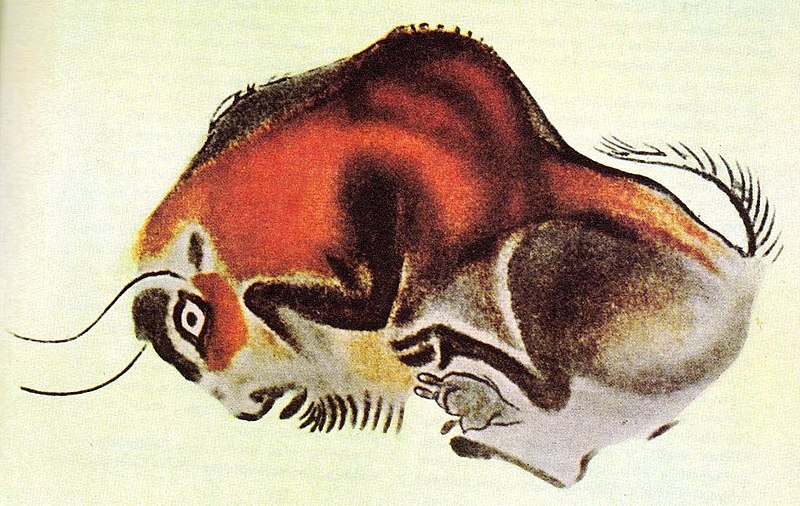
Friday Photography - Graffiti is Like Modern Day Cave Painting

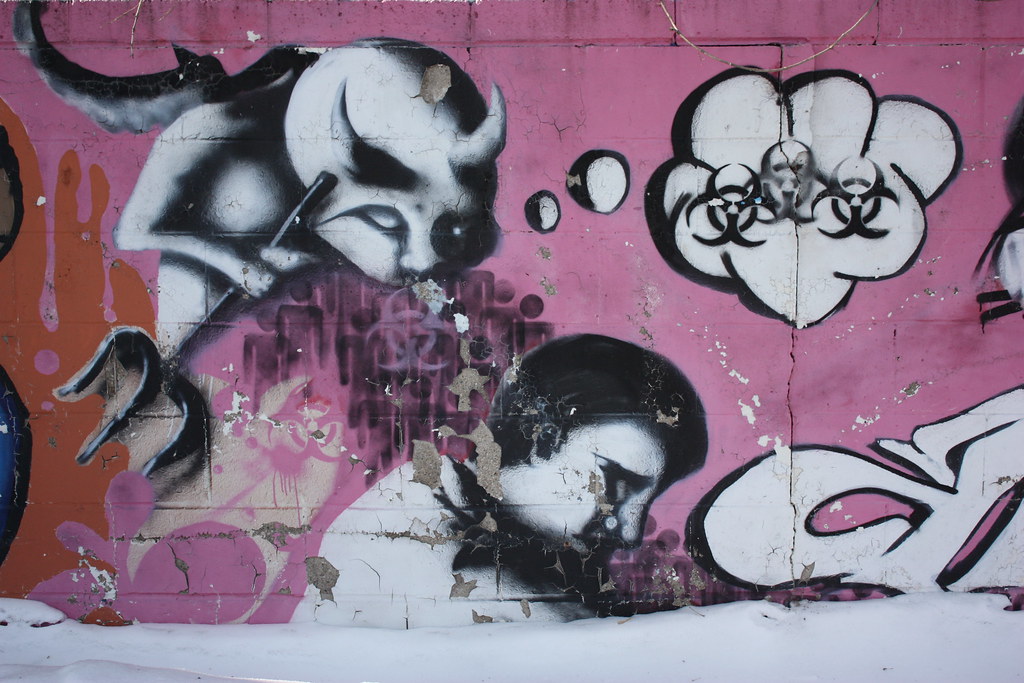
Graffiti is like modern-day cave painting. I don't mean that as a bad thing at all, I'm drawing a real parallel here. Get it? Drawing? But no seriously I was thinking about this a few weeks ago as I was snapping pictures of a beautifully graffitied wall in Minneapolis. It had all of this symbolism and obvious meaning, some of which I could understand, most of which I could not. And it made me think of a few famous cave paintings I'd seen in documentaries and pictures, particularly some from Africa and India.

Bison from the Altamira cave ceiling, 14,000 years old

There isn't real agreement between the experts about what cave paintings mean. Evidence suggests that they were not merely decorations of living areas, since the caves in which they have been found do not have signs of ongoing habitation. Additionally, the paintings are often in areas of caves that are not easily accessed.

Adept - Joy of the Mundane, 2008

Graffiti also isn't merely decoration, since most street art has a message whether it's "I was here" or "See what a great artist I am?" Graffiti is also often in areas of the city that are not easily accessed and generally not habitable (Not by people who have other places to habitate, at least).

Bhimbetka rock shelters in Madhya Pradesh, India, 9,000 years old

Like the nameless cave men and women who created the ancient works of art, most graffiti artists get no recognition. Worse yet, their artwork is often considered vandalism which can result in its destruction or erasure. As a result, street art is often only seen by other graffiti artists.

Imparting Evil - Sara Duane, 2010

Like cave paintings, graffiti of human forms are rare and usually don't look realistic (not to say that there aren't great realistic graffiti artists). One theory goes that cave paintings had religious connotations, that drawing people was taboo and the depicted figures held a sort of magic. Similarly, once a piece of street art has been finished, they are often left alone and in some ways revered. It is a major faux pas among the artists to cover another artist's work. Some pieces of Twin Cities street art have been around for years.

Spotted hyena painting in the Chauvet Cave, 30,000 years old

Though they look faded now, cave paintings were once vibrant and bright like modern graffiti. Cave painters had a wide range of artistic skill and were varied in age like modern-day street artists. Cave paintings communicate valuable insight into the culture and beliefs of their era, as graffiti art lends similar insights to modern day life.

Cheetah by Broken Crow - Joy of the Mundane, 2008

Cave paintings are thought to be brilliant by some, simplistic by others. Graffiti is viewed in a similar manner - some see graffiti as vandalism while others see it as a raw and honest form of art. You can tell what category this girl is in.

Bonus Street Art and Prehistoric Art Comparison

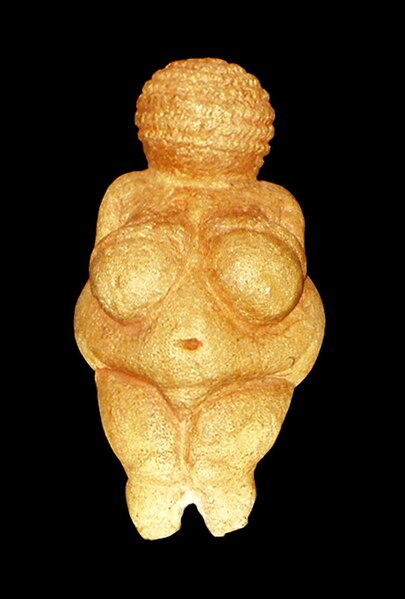
In the stone age and the modern age, women are a common artistic subject.

Venus of Willendorf, 24,000 years old

Black & White Figure - Joy of the Mundane, 2008

Sara Duane-Gladden is a freelance writer and photographer in the Twin Cities area of the great state of Minnesota.  

Thursday, February 4, 2010

I, Me, Us, We: Little Words, Big Impact

There are magic words that contribute to a happy marriage, but they might not be the ones you think. A new study suggests that spouses who use the language of "we" instead of the language of "me" are happier and better at resolving conflicts.

To the annoyance of singles everywhere, University of California in Berkeley researchers have found that couples who use pronouns such as "we," "our" and "us" have more harmonious relationships. Researchers analyzed conversations between 154 middle-aged and older couples about points of disagreement in their marriages. They found that those who used the words "we," "our" and "us" behaved more positively toward one another and showed less stress.

Conversely, couples who used pronouns such as "I," "me" and "you," emphasizing their "individuality" and "separateness," were found to be less satisfied in their marriages. The findings were especially true for older couples. According to the study, the use of these pronouns by older couples was most strongly linked to discordant relationships.

What's more, the study found that older couples who were together longer identified themselves more as "we" than their middle-aged counterparts. This suggests that facing obstacles and overcoming challenges together over a long period of time may give couples a greater sense of shared identity.
"Individuality is a deeply ingrained value in American society, but, at least in the realm of marriage, being part of a 'we' is well worth giving up a bit of 'me,'" said UC Berkeley psychology professor Robert Levenson, a co-author of the study published last semester in the journal Psychology and Aging.
Earlier studies have shown that use of "couple-focused" language is a strong indicator of happiness in the relationships of younger people. This study shows how this factor plays out over time as relationships become more mature, with couples either becoming closer or more polarized with their disagreements.
"The use of 'we' language is a natural outgrowth of a sense of partnership, of being on the same team, and confidence in being able to face problems together," said study co-author Benjamin Seider, a graduate student in psychology at UC Berkeley.
Researchers would like to note that the person using the "we" word is not the one who receives the most benefit. Rather, the words have a soothing effect on the partner, creating a feeling of unity and attachment. Use of "me" words carries with them an inherent separateness.

So, to give your relationship a boost, try sprinkling in a liberal amount of "our," "us," and "we," and do away with the "you," "I," and "me." It's less fattening than candy, cheaper than flowers, and more likely to create a lasting impression.

Monday, February 1, 2010

Haiku News - February 1, 2010

Three groundhogs and a
marmot are set to predict
the length of winter.

Cleopatra's eye
make-up offered protection
against diseases.

Lake Calhoun Pilots
have started a trend, as planes
touch down everywhere.

In Minnesota,
the chicken playing chicken
would be dead by now.

Great. Now some asshat
will equate green practices
with terrorism.

Twenty "incidents"
at nuclear plants
in just a few years.

Baltic is likely
the luckiest dog on the
planet at this time.

I believe its a
Louisianans right to
use the term “Who Dat.”

Whatever you do,
do not eat the Hawaiian
Butterfish, ever.

Seriously, they
are on a bike, you - a car.
Just drive away, jerk.