Saturday, March 26, 2011

Diagram Prize for Oddest Title of the Year 2011

This year's Diagram Prize for Oddest Title of the Year has been awarded to a book advising dentists on how to run their practices Mongolian warlord style. The prize was decided by a public vote on The Bookseller's website.

"Managing a Dental Practice: The Genghis Khan Way" by former dentist Michael Young won the prize on Friday. The book offers a guide on empire-building in the dentistry field. Young argues that warmongering tenacity is required to build a successful business. The book includes chapters on managing conflicts, team-building and planning for disasters.

The book beat finalists including "8th International Friction Stir Welding Symposium Proceedings," which detailed a friction stir welding symposium that occurred in Germany last May, and a romance novel called "The Italian's One-Night Love Child" by Cathy Williams. Other books that were shortlisted for the vote were "What Color is Your Dog? Train Your Dog Based on His Personality 'Color'" (Yes, you read that correctly) by Joel Silverman, "Myth of the Social Volcano: Perceptions of Inequality and Distributive Injustice in Contemporary China" by Martin Whyte and "The Generosity of the Dead: A Sociology of Organ Procurement in France" by Graciela Nowenstein.

Last year's winner, "Crocheting Adventures with Hyperbolic Planes" by Daina Taimina, saw its sales increase by 1,500% in the first month after winning the prize. Other past winners of the prize include "Living with Crazy Buttocks" by Kaz Cooke, "Greek Rural Postmen and their Cancellation Numbers" by Derek Willan, "Highlights in the History of Concrete" by C. C. Stanley and "Bombproof Your Horse" by Rick Pelicano and Lauren Tjaden.

Actual books, really. I looked them up. They really do exist, though some are expectedly out of print.

Run by trade magazine The Bookseller, the prize was founded in 1978. Its rules say the books must be serious and their titles cannot just be a gimmick.

Source: Mongol warrior’s tooth tips wins odd book title prize
Source: Genghis Khan dentistry book wins odd title prize

Wednesday, March 16, 2011

Fourth Annual Saint Paul Sidewalk Poetry Contest

It’s time for the Fourth Annual Saint Paul Sidewalk Poetry Contest. I am not a St. Paul resident, so I can't participate, but I bet at least one reader of this post could.

Look down! Some of Saint Paul's sidewalks are paved with poetry. Since the Every Day Poems for City Sidewalk program began in 2008, 31 poems have been impressed into the cement of 268 of the city's sidewalks.

Once again, the St. Paul Public Works Department and Public Art Saint Paul invites would-be bards to submit their poems to the citywide contest. Winning poems will be permanently “published” in the cement of a sidewalk.

For this year's edition, organizers are requesting short poems, preferably those with a topic revolving around nature and the outdoors. Poems may be inspiring, humorous or thoughtful, as long as it is appropriate for the general public. St. Paul residents of all ages are invited to participate. Up to 5 poets will receive a $150 prize and citywide honor.

An example from a previous contest winner:
A dog on a walk
is like a person in love −
You can't tell them
it's the same old world. 
By Pat Owen
Additionally, Poet John Minczeski will lead two workshops for burgeoning poets on Saturday, April 9. The first is at Merriam Park Library, 1831 Marshall Ave., from 10:30 a.m. to 12:30 p.m. 651-642-0385. The second is at the Rice Street Library, 1011 Rice Street from 2 p.m. to 4 p.m. 651-558-2223.

The contest began March 15 and ends April 17 at midnight. For more information and to submit entries, visit www.stpaul.gov/poetry.

Friday, March 11, 2011

10 Most Endangered Languages in the World

I have been meaning to post this for a while. Someone sent me an article exploring the 10 Most Endangered Languages in the World to me knowing that I'd find it interesting.

We tend take languages like English, German, French, Spanish and Mandarin for granted. Because they are so widely spoken, we expect them to be around forever. Provided humanity doesn't manage to kill itself in the next few decades, that may not be the case in the future. Dialects rise and fall just as civilizations do.

Many languages that currently exist were at one time spoken by many, but are alive today only because a single speaker is still breathing. Often, that lone speaker is geriatric. Sometimes, they are suffering from dementia. Ethnographers and linguistics experts calculate that at least one language slips into silent extinction every two weeks.

Here are three of the 10 Most Endangered Languages in the World:
Apiaca: Also referred to as Apiaka, Apiake, and Apiaca, these Brazilian peoples find their language and way of life threatened by the gradual creep of Portuguese into the Mato Grosso region. Considered a subgroup of Tupi (specifically Tupi-Guarani), the language only appears to have one remaining speaker in 2007. This in spite of an ethnic population hovering around 192 people.

Kaixana: The last known individual to boast Kaixana as his primary language was Raimundo Avelino. He was 78 as of 2008, living in the Limoeiro, Amazonas, Brazil, and seems to still be kicking around as of February 2011. As far as ethnographers and linguists know, he is the last of the Kaixana speakers.

Kulon-Pazeh: Various Sinitic dialects popularly spoken in Taiwan endangered Kulon-Pazeh (also known as Kulun) to the point it went officially extinct after the 2010 death of Pan Jin-yu. She worked fiercely to educate her peoples in their native tongue, so it continues to hobble along as a second language rather than a primary. However, the overall outlook remains grim, especially considering its status as a "home language" since the 1930s.
Read the rest of the 10 Most Endangered Languages in the World at Online Colleges.

Friday, March 4, 2011

Friday Photography - New Background Wallpaper

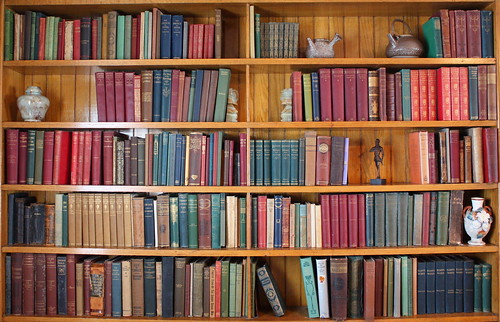
This is my blog. There are many like it, but this one is mine. Recently, I revamped it with a new look and the nifty bookshelf photo below was the wallpaper. That is, until I realized just how many other blogs True to Words resembled after the change.

Image by luoman.

So, inspired by the "template," I made my own background wallpaper. I went to my favorite place, the historical Ames Florida Stork House Museum and took some photos in the home's upstairs library. Below, you can see the full result.


Of course, I like my version better. :) The shelves may be warped and crooked and the worn bindings are not as "neat" as the generic books of the first photo. But these books actually mean something to me. Not only do I contribute towards their care by volunteering my time at the house, but my friends William Shakespeare, Washington Irving, Mark Twain, Homer and Aesop are on those shelves.

This was also my Thursday photo for my 365 project.

Sara Duane-Gladden is a freelance writer and photographer in the Twin Cities area of the great state of Minnesota.