Showing posts with label Journalism. Show all posts

Tuesday, May 3, 2011

World Press Freedom Day 2011

May 3 is World Press Freedom Day. Its observance aspires to raise awareness of why press autonomy is important and remind governments of their duty to uphold the human right to freedom of expression.

The day was chosen to mark the anniversary of the Declaration of Windhoek. Written two decades ago in 1991 by African newspaper journalists who had experienced intimidation, imprisonment and censorship for performing their jobs, this statement of press freedom principles calls for independent and pluralistic media throughout the world. The declaration also asserts that freedom of expression is more than a fundamental human right: A fully independent press is also essential for a successful democracy to flourish.

The United Nations Educational, Scientific and Cultural Organization (UNESCO) marks World Press Freedom Day each year with a conference that brings together media professionals, press freedom organizations and UN agencies to discuss the state of press freedom worldwide and solutions for how to address the difficulties. For the first time ever, the 2011 World Press Freedom Day conference is being hosted by the United States. It began on May 1 in Washington, D.C. and continues through today.

The theme of this year's event is "21st Century Media: New Frontiers, New Barriers". Its aim is to re-affirm basic principles of media freedom in the digital age, 20 years after the original declaration was made in Windhoek, Namibia, to address print publishing and long before the Internet, mobile phones and social media were ubiquitous. More and more, "citizen journalists" are playing a major role in reporting the news, especially in the Middle East and North Africa.

The timing of World Press Freedom Day this year is significant in light of recent events during which several notable journalists, media assistants and "netizens" lost their lives or were imprisoned while trying to gather information in war-zones. As of the time this post was published, 18 journalists and 2 media assistants have been killed and 151 journalists, 9 media assistants and 128 netizens have been imprisoned, according to figures tracked by Reporters Without Borders.

Reporters Without Borders has also released its 2011 list of predators of press freedom. Most notably, some people are missing this year compared to the 2010 list due to citizen rebellions. The first to go was Tunisia’s President Zine el-Abidine Ben Ali, who was forced to step down in January.
Other predators such as Yemen’s Ali Abdallah Saleh, who has been overwhelmed by the wave of protests sweeping his country, or Syria’s Bashar al-Assad, who is responding with terror to his people’s democratic aspirations, could also fall. And what of Muammar Gaddafi, the Guide of the Revolution, now the guide of violence against his people, a violence that is deaf to reason? And Bahrain’s King Ben Aissa Al-Khalifa, who should one day have to answer for the deaths of four activists in detention, including the only opposition newspaper’s founder, and the vast repressive operation against pro-democracy protesters?
Freedom of expression has been one of the first demands of the region’s peoples, one of the first concessions from transitional regimes, and one of the first achievements, albeit a very fragile one, of its revolutions.
See the full list of all 38 predators to press freedom from Reporters Without Borders site.

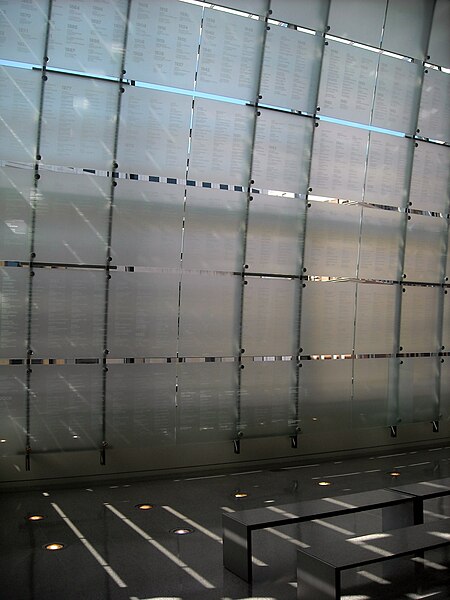
About the image: Located in the Newseum in Washington, D.C., the Journalists Memorial pays tribute to reporters, photographers and broadcasters who have died reporting the news. The names of 2,007 individuals from around the world are etched in its glass currently. The memorial is rededicated each year to add the names of journalists who lost their lives in the preceding year.

Thursday, May 6, 2010

Reporters Without Borders Name 40 Predators of Press Freedom

There are 40 names on the 2010 list of Predators of Press Freedom, as determined by Reporters Without Borders. The list includes politicians, government officials, religious leaders, militias, and criminal organisations that treat the press as an enemy and directly attack journalists. Many of this year's perpetrators were already on last year's list.

North Korea's leader Kim Jong-il and the head of Burma's military government Than Shwe are on the list. Iran's "president" Mahmoud Ahmadinejad and Libya dictator Muammar Gaddafi also made the list. Yemeni President Ali Abdulah Saleh has been added this year, as well as Taliban leader Mullah Omar, who has directly targeted journalists and news media 40 times in 2009 in a bloody war waged to control media coverage.

Reporters Without Borders also named Mexico as one of the most dangerous countries for journalists. 62 journalists have been killed in Mexico in the last 10 years.

Reporters Without Borders has fought for press freedom on a daily basis since it was founded in 1985. In the past 15 years, access to information has cost the lives of more than 850 journalists. Reporters Without Borders defends journalists and media assistants imprisoned or persecuted for doing their job and exposes the mistreatment and torture of them in many countries. It fights against censorship and laws that undermine press freedom. The organization gives financial aid each year to 100 or so journalists or media outlets in difficulty (to pay for lawyers, medical care and equipment) as well to the families of imprisoned journalists. All the while working to improve the safety of journalists, especially those reporting in war zones.

Here is the full list of 40 press-hating perpetrators in alphabetical order. To learn more about each one, visit the Reporters Without Borders map.

Abdallah ibn Al-Saud - Saudi Arabia King
Alexander Lukashenko - Belarus
Ali Abdallah Saleh - Yemen
Ali Khamenei - Iran
Bashar Al-Assad - Syria
Choummaly Sayasone - Laos
ETA - Spain
Executive Force - Palestinian territories
FARC - Colombia
Gotabhaya Rajapakse - Sri Lanka
Gurbanguly Berdymukhamedov - Turkmenistan
Hu Jintao - China
Ilham Aliev - Azerbaijan
Islam Karimov - Uzbekistan
Islamist militias - Somalia
Israel Defence Forces - Israel
Issaias Afeworki - Eritrea
Kim Jong-il - North Korea
Mahmoud Ahmadinejad - Iran
Mswati III - Swaziland
Muammar Gaddafi - Libya
Mullah Mohammad Omar - Afghanistan
Nepalese armed groups - Nepal
Nong Duc Manh - Vietnam
Nursultan Nazarbayev - Kazakhstan
Ogbonna Onovo - Nigeria
Organised crime - Italy
Paul Kagame - Rwanda
Private militias - Philippines
Ramzan Kadyrov - Russia
Raúl Castro - Cuba
Robert Mugabe - Zimbabwe
Sinaloa, Gulf and Juárez Cartel - Mexico
Teodoro Obiang Nguema - Equatorial Guinea
Than Shwe - Burma
The Palestinian Authority's security forces - Palestinian territories
Vladimir Putin - Russia
Yahya Jammeh - Gambia
Zine el-Abidine Ben Ali - Tunisia President
'Black Eagles' - Colombia