Showing posts with label Words. Show all posts

Thursday, March 31, 2016

The Word: Retronym

I found a new word! I love new words. And what's great about this word is it describes making new words out of old words. The word? Retronym.

retronym: \ˈretrōnim\

Date: 1980

Function: noun

: a new term for something that differentiates the original from a more recent form or version

Giving something old a new name. It happens often due to progress or the advancement of technology. For example, the term "acoustic guitar" was sparked after the arrival of electric guitars - before then, it was just a guitar. Anything with "old fashioned" or "classic" included in the name is a retorynm, such as "Coca Cola Classic" or "old fashioned ice cream." Retronyms are also created in other ways, though, such as the initiation of the phrases "Contiguous United States" or "Lower 48" after Alaska and Hawaii became states.

Retronyms can also be applied to people. When a ruler has or adopts the same name as a predecessor, the Roman numeral I is added to the original's name retroactively (if he hadn't already used one during his lifetime). In the United States, when a son is named after the father (Jr.), the elder may be given the suffix Senior (Sr.).

Now that you've had a crash course on what they are, you've probably realized you use retronyms all the time. There's a nice list here, but I've included 10 of my favorite retronyms below:
  1. Analog clock: Before the invention of digital clocks, most clocks had faces and hands. Related: Analog watch.
  2. Bar soap: This term arose with the advent of shower and bath soaps in liquid and gel form. Mmmm, bubbly loofas.
  3. Corn on the cob: This Minnesota favorite used to be called simply "corn" before canned corn became widely available.
  4. Landline phone service: Before cellphones and smartphones, this term was generally only used by military personnel and amateur radio operators.
  5. Real numbers: This phrase was coined after the invention of the imaginary numbers, which are a very real thing.
  6. Black-and-white television or movie:  It was just "the movies" or "television" until color television came along. Furthermore, the retronym "Standard Definition Television" has become necessary to differentiate it from HDTV (high definition). Related: Silent film.
  7. Snail mail or postal mail: Before email and voice mail, all mail was simply mail. Obviously much slower by comparison – thus, the "snail" addition.
  8. Star Trek: The Original Series: It used to be just Star Trek, but this retronym became a necessity after a multitude of movies and spinoffs.
  9. Offline: Also known as "face to face," or "in real life" (IRL). Before computer and smartphones came around, the ways to communicate were landline phone, snail mail, or face to face. Now there's so many ways people can interact online, we had to coin a new term to describe reality and daily life. Think on that for a moment.
  10. Regular coffee: Personally I think it should be "real coffee," but whatever it's called, I just need to be able to tell it apart from the decaffeinated stuff.
  • Bonus: Star Wars Episode IV: A New Hope. When it was released in 1977, it was just Star Wars. The new title was applied after the first sequel was introduced. Now Star Wars refers to the entire series. 
Strange things happen to language over the course of time: Sometimes retronyms flip around. When razors with encased blades were introduced, they were called "safety razors" to distinguish them from what at the time was just simply "razors". Now, we would never call those plastic things a safety razor, we tend to just call it a razor, and we refer to the original style of razors generally as "straight razors" or "cut-throat razors".

Retronyms. New words to describe old things. The process of applying these labels obviously has been happening for a long time as new things are invented. It's interesting that we didn't have a word to describe this process until a relative short while ago. As technology speeds along, we're sure to see more of them pop up in the future.

Sara Duane is a freelance writer in the Twin Cities area of the great state of Minnesota.   

Wednesday, January 2, 2013

A Compilation of Word Lists for 2012 & 2013

Every year, there are dozens of different major word lists and countless more minor words lists that are presented. I usually like to try to discuss them and this year is no different (check out the word lists for 2010 and word lists for 2011).

Except, it seems like there are a lot more of them for this year. Here is a compilation of some of the best word lists for 2012, as well as predictions (or hoped banishments) for 2013.

Merriam-Webster's Most Looked-Up Words of 2012
Merriam-Webster's most looked-up words of 2012 are "socialism" and "capitalism." The rest of the list includes "malarkey," "globalization," "marriage" and "bigot." Could you tell it was an election year?

The American Dialect Society's Words of 2012
The American Dialect Society's 2012 words list also includes many campaign-related words, but not all of them are as such. My favorites on this list are "Eastwooding" and "hate-watching." Who hate-watches anything, anyway? Sounds like a waste of time and energy.

The Financial Times Lexicon Top 10 of 2012
The FT Lexicon's word list for 2012 is a little different, as this finance-related publication has a list of words that reflects its industry. "Mutual fund" was the top term, followed by "recession" at number two. Hey, it seems "fiscal cliff" is at number 10! Haven't heard that phrase before.

Collins' Online Dictionary Words of 2012
Collins' Online Dictionary's word list presents a word for each month of 2012. "Gangnam style" is introduced for September. "Fiscal cliff" is not surprisingly the word for December. Is there a trend?

The Atlantic's A-Z Guide to 2012's Worst Words
This is quite a list! A very thorough analysis of words that were born or overused during 2012, from "actually" and "YOLO" to (gasp!) "fiscal cliff" and "legitimate rape," this list is a great place to start for words to banish for 2013. I can handle YOLO, but seriously, can we ban "fiscal cliff" already?

Words That Need to Be Retired in 2013
The Atlantic had a great list, but the SF Weekly didn't quite think it was enough and added its own words to the list, including "adorkable" and "ZOMG!" Excellent additions, in my opinion.

New words of 2012: What a Shamazing Year
Are you noticing that a lot of 2012 words are ones that people never want to hear again? The Telegraph's 2012 list had a distinctly British flavor and was almost entirely made out of portmanteaus, including "brandalism" and "Eurogeddon." We really are fans of combining two words together, aren't we?

Words You'll Hear Plenty in 2013
BusinessNewsDaily interviewed small business owners, PR people, entrepreneurs and others to discover which buzzwords we may see in 2013. The list again includes a lot of portmonteaus like "phablets," "advertainment" and "tri-ti-tasking." I guess we'll be multitasking even more in 2013! And possibly starting a trend of combing three words together.

2012: The Year in Food Words
Finally, a topic that everyone loves. This list is unique in that it compiles the best food-related words that were popular in 2012. Most notable on this list, in my opinion, are ultra-pizza (yum!), potato movement and buzz bars.

What would you add or subtract from this list - either words we heard a lot in 2012 or words you don't want to hear anymore in 2013?

Thursday, January 12, 2012

A Compilation of Word Lists for 2011 & 2012

The end of one year and beginning of the New Year always means that people will come up with different types of lists to try to capture an image of what happened. There are lists of popular gadgets, amazing scientific discoveries, best selling cars and, of course, words.

Every year, there are at least a dozen different major word lists and countless more minor words lists. So inspired, even made my own top words of 2011 for True to Words. Here is a compilation of some of the best word lists for 2011, as well as predictions for 2012.

Global Language Monitor's Top 10 Words of 2011
Employing a technology known as NarrativeTracker, the Global Language Monitor analyzes English language usage on social media, the Internet, the blogosphere and in the top 75,000 print and electronic global media sources in order to select the 10 most used terms of the year.

American Dialect Society's 2011 Words of the Year
In its 22nd annual words of the year vote, the American Dialect Society determined the most useful, creative, unnecessary, outrageous, euphemistic and other words for the 2011 year. This is a fun list!

Most overused LinkedIn profile words of 2011
The online professional network LinkedIn analyzed the resumes of its 135 million users to determine that the term "creative" is most overused term on profiles in the United States, Australia, Canada, Germany, the Netherlands and the United Kingdom. Dang, creativity is one of my favorite words!

Most Annoying Words of 2011
Once again, the Marist Poll has revealed the word or phrase considered to be the most annoying in casual conversation. For the third consecutive year, “whatever” is the "winner" of this title for 2011.

Top Ten Most Politically Contentious Terms of 2011
The intro sentence says it all: "The year 2011 was tumultuous for politics. With both ends of the political spectrum deeply committed to their ideologies, the rhetoric and vitriol each used to attack the other side’s priorities have been more contentious and polarizing than ever."

Banished Words For 2012
In 1976, Lake Superior State University in Michigan released its first "List of Words Banished from the Queen's English for Misuse, Overuse and General Uselessness". Here is your list for 2012!

Top Words of 2012 Predictions
The Global Language Monitor not only analyzed the popular words of 2011, it made predictions for what the most-used words of this year might be. Are you prepared to peek into the future of language?

Thursday, February 10, 2011

Longest Words in the English Language

When I was in high school, some of my classmates and I had a lengthy debate about what was/is the longest word in the English language. At the time, we landed on "antidisestablishmentarianism," because we decided "supercalifragilisticexpialidocious" wasn't really a word. Sorry, but really, its not.

antidisestablishmentarianism: [\an-tee-dis-uh-stab-lish-muhn-tair-ee-uh-niz-uhm\]
Date: 1838
Function: Noun
: opposition to the withdrawal of state support or recognition from an established church, especially the Anglican Church in 19th-century England.

It turns out, I learned later, that at 28 letters, this word isn't the longest in English. Weighing in at a hefty1,185 letters long, the name of a tobacco virus was deemed the longest word. Are you ready? Take a deep breath and say:

acetylseryltyrosylserylisoleucylthreonylserylprolylserylglutaminylphenylalanylvalylphenylalanylleucylserylserylvalyltryptophylalanylaspartylprolylisoleucylglutamylleucylleucylasparaginylvalylcysteinylthreonylserylserylleucylglycylasparaginylglutaminylphenylalanylglutaminylthreonylglutaminylglutaminylalanylarginylthreonylthreonylglutaminylvalylglutaminylglutaminylphenylalanylserylglutaminylvalyltryptophyllysylprolylphenylalanylprolylglutaminylserylthreonylvalylarginylphenylalanylprolylglycylaspartylvalyltyrosyllysylvalyltyrosylarginyltyrosylasparaginylalanylvalylleucylaspartylprolylleucylisoleucylthreonylalanylleucylleucylglycylthreonylphenylalanylaspartylthreonylarginylasparaginylarginylisoleucylisoleucylglutamylvalylglutamylasparaginylglutaminylglutaminylserylprolylthreonylthreonylalanylglutamylthreonylleucylaspartylalanylthreonylarginylarginylvalylaspartylaspartylalanylthreonylvalylalanylisoleucylarginylserylalanylasparaginylisoleucylasparaginylleucylvalylasparaginylglutamylleucylvalylarginylglycylthreonylglycylleucyltyrosylasparaginylglutaminylasparaginylthreonylphenylalanylglutamylserylmethionylserylglycylleucylvalyltryptophylthreonylserylalanylprolylalanylserine: [Yeah right, I can't find any online sources that articulate how this word is articulated]
Date: 1964
Function: Noun
: Chemical name for the tobacco mosaic virus (TMV), a positive-sense single stranded RNA virus that infects plants, especially tobacco and other members of the family Solanaceae

Then last month I found this article from NPR that explores the longest words in the English language. The usual suspects were included in the debate, mainly the three words already listed in this blog post. Then there, at the end, was a different word that is even longer than the TMV virus' chemical name. Weighing in at a whopping 1,913 characters, enter:

methionylglutaminylarginyltyrosylglutamylserylleucylphenylalanylalanylglutaminylleucyllysylglutamylarginyllysylglutamylglycylalanylphenylalanylvalylprolylphenylalanylvalylthreonylleucylglycylaspartylprolylglycylisoleucylglutamylglutaminylserylleucyllysylisoleucylaspartylthreonylleucylisoleucylglutamylalanylglycylalanylaspartylalanylleucylglutamylleucylglycylisoleucylprolylphenylalanylserylaspartylprolylleucylalanylaspartylglycylprolylthreonylisoleucylglutaminylasparaginylalanylthreonylleucylarginylalanylphenylalanylalanylalanylglycylvalylthreonylprolylalanylglutaminylcysteinylphenylalanylglutamylmethionylleucylalanylleucylisoleucylarginylglutaminyllysylhistidylprolylthreonylisoleucylprolylisoleucylglycylleucylleucylmethionyltyrosylalanylasparaginylleucylvalylphenylalanylasparaginyllysylglycylisoleucylaspartylglutamylphenylalanyltyrosylalanylglutaminylcysteinylglutamyllysylvalylglycylvalylaspartylserylvalylleucylvalylalanylaspartylvalylprolylvalylglutaminylglutamylserylalanylprolylphenylalanylarginylglutaminylalanylalanylleucylarginylhistidylasparaginylvalylalanylprolylisoleucylphenylalanylisoleucylcysteinylprolylprolylaspartylalanylaspartylaspartylaspartylleucylleucylarginylglutaminylisoleucylalanylseryltyrosylglycylarginylglycyltyrosylthreonyltyrosylleucylleucylserylarginylalanylglycylvalylthreonylglycylalanylglutamylasparaginylarginylalanylalanylleucylprolylleucylasparaginylhistidylleucylvalylalanyllysylleucyllysylglutamyltyrosylasparaginylalanylalanylprolylprolylleucylglutaminylglycylphenylalanylglycylisoleucylserylalanylprolylaspartylglutaminylvalyllysylalanylalanylisoleucylaspartylalanylglycylalanylalanylglycylalanylisoleucylserylglycylserylalanylisoleucylvalyllysylisoleucylisoleucylglutamylglutaminylhistidylasparaginylisoleucylglutamylprolylglutamyllysylmethionylleucylalanylalanylleucyllysylvalylphenylalanylvalylglutaminylprolylmethionyllysylalanylalanylthreonylarginylserine: [BWAHAHAHAHAHAHAHAHA! I dare you to try and pronounce it]
Date: ???
Function: Noun
: Full chemical name of tryptophan synthetase A protein, which partners with tryptophan synthetase B protein to create tryptophan, an essential amino acid

While searching to find the official definitions and spellings of these words for this blog post, I found yet another word, and this one takes the cake (and is so long, it won't be printed here). Numbered at a gigantormous 189,819 characters, check out the real longest word in the English language (click the link to see the full name).

titin:  [\tit-in\]
Date: ???
Function: Noun
: the shortened name for a protein that in humans is encoded by the TTN gene; also known as connectin

But the NPR article made a really good point about whether these words are used or not. Though the full words for tryptophan synthetase A protein and titin are quite long, they haven't been published in usage. The TMV virus name, however, was published in science journals in the 1960s. Since that time, there have been bigger, longer molecules that could be words, but publications don't bother to spell them because it uses up large amounts of space and paper. And really, did anyone reading this blog post even read the words all the way through? I wrote it, and I didn't.

My further research also lead me to wonder about these "longest" words, as even linguists disagree whether they should even exist because of their highly technical nature. There are obviously shorter words that are used much more commonly in references to these nouns. Surely since it is easier to say and requires fewer breaks for breathing than its full name, titin must be thrown around much more often than the methionylthreonylthreonylglutamin-what-a-novel-of-a-word.

Also, some of the "shorter" words that are still exceptionally long are disputed. Lopadotemachoselachogaleokranioleipsanodrimhypotrimmatosilphioparaomelitokatakechymenokichlepikossyphophattoperisteralektryonoptekephalliokigklopeleiolagoiosiraiobaphetraganopterygon is a 183 letter word that refers to a fictional dish mentioned in Aristophanes' comedy Assemblywomen, but its an English transliteration of an ancient Greek word that has never appeared in a dictionary. And pneumonoultramicroscopicsilicovolcanoconiosis, at 45 letters long, was actually coined specifically to serve as the longest English word and is the longest to ever appear in the dictionary. It's a lung disease that is more commonly called silicosis. But if its coined to be the longest, is that cheating?

So after all of those words are shoved to the side, either because their challenged or coined, what is left? Its 35 letters long and you're never going to guess what it means.

hippopotomonstrosesquippedaliophobia: [\hippo-poto-mons-stro-ses-quipped-alio-phobia\]
Date: ???
Function: Noun
: The fear of long words.

Sara Duane is a freelance writer in the Twin Cities area of the great state of Minnesota.   

-----
Resources:
What's The Longest Word In The English Language?
Longest word in English

Thursday, December 30, 2010

Words of the Year for 2010

It is the last days of 2010, which of course means lists of the "top whatevers" in various forms for the year. Being that this is a blog about language and writing, I've compiled a list of some of the best word-related lists for 2010.
What words will be popular in 2011? Only time will tell.

Thursday, November 18, 2010

The Word: Plagiarism

The words "plagiarize" and "plagiarism" are popping up in the news lately. These words can chill a creative soul to the bone, and I am no exception. To commit plagiarism is "to plagiarize":

plagiarize: \ˈplā-jə-ˌrīz\

Date: 1716

Function: transitive verb
: to steal and pass off (the ideas or words of another) as one's own : use (another's production) without crediting the source

Function: intransitive verb
: to commit literary theft : present as new and original an idea or product derived from an existing source

Plagiarism seems to be everywhere, from cooking magazines to J.K. Rowling's popular Harry Potter book series. And you wouldn't believe the people being accused of plagiarizing other people's work, such as Oprah Winfrey, "South Park" creators and satire specialists Matt Stone and Trey Parker, even the former president of the United States, George W. Bush. At all levels of publication and even higher-level academics, the world of writing is rife with word thiefs, idea pirates, and otherwise plain old copyright infringers.

Plagiarism is a huge problem, particularly on the internet. Because everything on the internet is so easily copied, pasted, and reproduced, its not hard to understand why people like Cooks Source editor Judith Griggs believe everything on the web is in the "public domain." The subject doesn't have to be an article or a memoir, no one's content is off limits to these charlatans, it can be as personal as your own past! Just ask graphic designer Clay Butler who has had his biography stolen in various forms by many tricksters, sometimes the same person more than once.

So why do people do it? Well, at the very least it is just easier to pass off someone else's work as your own than to buckle down and actually do it yourself. Another reason may be for profit, such as discount content services that promise vast quantities of "unique" text at prices that would baffle any self-respecting writer who values themselves and their work. Other people, like the Black Eyed Peas (who have been sued repeatedly for plagiarism) and even Supreme Court Associate Justice Mariano del Castillo just seem to think that they can get away with it. Poor planning, ineptitude, even writer's block are all reasons that can contribute to a person choosing to plagiarism but I think what most plagiarists have in common is one very specific characteristic: They want to impress others.

Whether its the boss, colleagues, their friends, their professor, potential employees, future clients or even random readers, I think most plagiarists steal other peoples words, ideas, and experiences because they wish they could claim them as their own. They want others to believe that they're creative, intelligent, deep. Instead of showing those qualities by accomplishing something uniquely their own, they disprove themselves by doing the opposite.

But plagiarism is a shallow crime that can be easily revealed. First of all, duplicate content and plagiarism detection software are making this crime harder to accomplish. Additionally, the stories of plagiarists who are trying to co-opt other people's experiences can be easily shot down by witnesses or even just people who have an interest in rooting out creativity theft. Finally, as in the case of plagiarized resumes and bios, when someone claims they have a specific skill and yet fails to accomplish that task in a satisfactory way, it becomes apparent that person lied about his or her qualifications.

Then what follows next?

Public shaming, endless ridicule, humble apologies, lost jobs, and expensive lawsuits. Because whether its a song, a book, a website, a blog, a photo, a logo, a graphic, or any other copyrighted item, the person or people who created it will defend their work against infringement to whatever degree they can. After all, it is their intellectual property and likely their livelihood. And as proven by the purported collapse of Cooks Source, even if the case doesn't end up in court, a verdict and punishment for plagiarism can be doled out quite swiftly through social media justice.

For anyone who would pursue this type of behavior, I would advise them to determine whether the short term gain that can be accomplished through plagiarism is outweighed by the long-term stigma and repercussions of getting caught.

Thursday, June 24, 2010

Dinner vs. Supper

Dinner and supper. They seem so interchangeable. They both can refer to the last meal of the day. And it seems that the preference for "dinner" over "supper" is both regional and generational. In the south and the east it is supper that reigns, and in the north and the west, dinner is, well, what's for dinner. Older people tend to say supper while the younger generations lean toward dinner. What are the actual differences between the meanings of these words?

A quick search of "Dinner vs. Supper" drew quite a few results with few answers. There are plenty of other people confused about what the difference is between the words. The most thorough explanation for dinner vs. supper came from Digital Streets.

According to Wikipedia, and mentioned at Digital Streets, supper is the name for a light evening meal that followed dinner. The term is derived from the French souper, which is related to soup. It is also related to the German word for soup, which is "Suppe".

On the other hand, Wikipedia says that dinner originally referred to the first meal of the day, a heavy meal usually eaten about noon. Eating this noon-time dinner "broke the night's fast" in the new day, and in Old French, circa 1300, "disner" actually meant "breakfast." Further, the lighter meal following dinner has traditionally been referred to as supper, implying they're not so interchangeable after-all.

So dinner isn’t lunch or supper, it's breakfast, and supper, which follows dinner, is really lunch? That's confusing enough, and that's where DS ended the comparison. But there is at least one more difference between dinner and supper: Class differences.

In colonial days, farmers were too busy to eat three meals a day, so they only ate breakfast and dinner. Cooking for the second meal started almost immediately after the first meal of the day because it saved the woman of the household from having to restart the hearth fire.

The wealthy had three meals a day, though: breakfast, dinner, and supper. With urban occupations and more leisure time, there was ample time for eating. Later in the 19th century, cooks and servants allowed the wealthy to host grand dinner parties with lavish meals that lasted well into the evening.

As a result of this class difference then, referring to the evening meal as dinner is fairly formal now. Supper tends to be used to describe a less formal, simpler family meal. That makes sense when you think about it. When people go out on dates, they never talk about having supper, it is usually dinner. But when families are sitting down together for a meal in the evening, they often say "Supper is ready!"

In central Minnesota, I don't often hear people say supper but it still happens often enough for me to ponder the preference of dinner over supper or vice versa. Personally, I like the word dinner better. I can't quite put my finger on it, but something about the word supper sounds less appetizing. Maybe it has something to do with the popping of the "p" in supper - I also prefer saying soda to pop, which has a similar sound!

Which word do you prefer to call the final meal of the day?

Sara Duane is a freelance writer in the Twin Cities area of the great state of Minnesota. 

Wednesday, May 12, 2010

Soda vs. Pop

I like words. Obviously. :) My friends like words, too. We've had many conversations over the years about them, from lamenting the overuse of the word "like" to praising the proper usage of the word "literally". Often we're in agreement, but one argument which we've never been able to lay to rest is whether carbonated soft drinks should be called "soda" or "pop".

I am firmly in the soda category, as are some of my friends. And the ones who are not in the soda category are quite insistent that the "correct" word is pop. I would have to disagree. And they disagree with me.

There is no consensus on this, and there appears to be no rational argument. How do you argue this?

"It's pop."
"Why?"
"Because it is."
"No, it's soda."
"Now you're just being silly."

I did some digging on the subject, which didn't help me much. History seems to advocate that both words are perfectly valid. Soda works because soft drinks are made with soda-water, which create the fizz.  Pop was introduced by Robert Southey in 1812 "because ‘pop goes the cork’ when it is drawn."

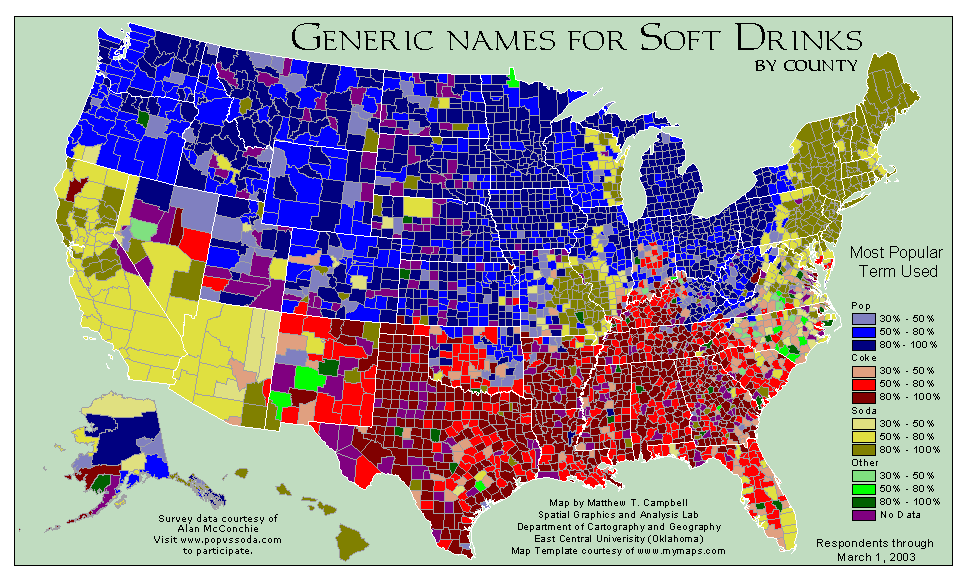
One person has apparently become so obsessed with it that they have created a Pop vs. Soda Controversy website intended to plot the regional variations in the use of the terms "Pop" and "Soda" to describe carbonated soft drinks.

The map throws a whole new monkey wrench into the equation with the additional term "coke". As in:

"I'd like a coke."
"What flavor?"
"Mountain Dew."

Now who is being silly?

The map does seem to show that soda is typical on the east and west coasts, pop is popular in the north, while coke is the word to use in the south. The raw statistics show what other names people use to refer to soft drinks, such as fizzy drinks or lolly water. Though I may feel a little outnumbered here in the Midwest, I will continue to say soda, not pop and certainly not coke.

Soda or pop: Which do you prefer?

Thursday, January 14, 2010

Collected Words of 2009 & the Aughts

I can't believe I missed these around the New Year. But I did catch them in time to do a haiku news about them. And since it is still within two weeks of the start of 2010, I think its okay that I mention them even if they are sooooooooo last year. ;)

The New York Times has a list of interesting buzzwords of 2009. This is a hodge-podge of common words used throughout the year. One sentence reads "Catchphrases and buzzwords can tell us much about a year past — what resonated, what stuck, what the year revealed about the sensibility of the nation, whether you’re a wise Latina woman, a mini-Madoff, a teabagger or Balloon Boy." Need I say more?

The 2009 Merriam-Webster's Words of the Year list is based on actual user lookups to the Merriam-Webster Online Dictionary and Online Thesaurus. The word of the year that received the highest intensity of searches over the shortest period of time is "admonish." A curious result.

On the other hand, the 2009 Word of the Year choice at Webster’s New World® College Dictionary was distracted driving. Not only is it quickly entering people's vocabulary as many are guilty of this on a daily basis, but it is rapidly entering law books around the world. One of their runner-up words is amusing and appalling at the same time:
wallet biopsy: examination, before medical service is provided, of a patient’s ability to pay, enabling the health care provider to decide whether free or discounted medical care is appropriate

The New Oxford American Dictionary's Word of the Year for 2009 was "unfriend." I think we all know what that one means! Along those same lines, the 121-year-old American Dialect Society chose "tweet" as the word for 2009. Going a step further, they also chose Google to be the word of the decade.Their voting process, which must satisfy the "crusty generation of veteran scholars and the giddy linguistic students whose jargon is a step ahead," sounds like it would be incredibly fun to sit in on. In fact, go ahead and read about it and watch the video!

The Global Language Monitor says its picks for the Top Words of the Decade were ‘Global Warming’, 9/11, and Obama followed by Bailout, Evacuee, and Derivative; Google, Surge, Chinglish, and Tsunami followed.

Noughtyisms: the Best Words of the Decade, is an article from the Guardian with a crazy list of unique, interesting words from around the world that were born in the new Millenium. Meh, smirting, helicopter mom. It even pointed out to me that "cellulite" was a local slang term in Minnesota for hail damage in 2006. Did not know that. Go ahead, it's a good, quick read.

9/11, iPod, friend, blog, and carbon made the top 5 words of the decade for the National Post. Additionally, i found this New York Post column which includes many of the English words I discussed here, but also talks about words of 2009 and the Aughts from around the world.

Finally, every year wordsmiths at Lake Superior State University issued their 35th annual list of words that they believe should be banned in 2010. Guess what? Some of the Words of the Year picked by other organizations and entities ended up on that list, including friend (in the verb form), unfriend, and tweet.

Phew. That was all of the ones I found. Any more, well, I guess I missed them! Oh how I wish the Urban Dictionary had a Word of the Year, but I couldn't find one. Better luck next year.

Good thing I'm done with this post, my spellchecker is not happy with all the portmanteaus!

Wednesday, April 22, 2009

The Word: Responsibility

Yes, The Word today is very similar to my accountability post from the beginning of April, but believe me, it is with purpose. So let's dig in.

responsibility: \ri-ˌspän(t)-sə-ˈbi-lə-tē\

Function: noun
Date: 1737

1: the quality or state of being responsible: as a: moral, legal, or mental accountability b: reliability, trustworthiness

2: something for which one is responsible : burden <has neglected his responsibilities>

Earlier, I stated that I was absolutely certain "accountability" was on the verge of seeing it's day in the sun. The reason, I stated, was in its definition of responsibility. Well guess what? Responsible, accountable, and their related variations are popping up everywhere in advertising, politics, and every-day life.

Case in point, when I went to good old Merriam-Webster's to get the definition of responsibility, their sponsored link was one of the advertisers I've been watching: Liberty Mutual. Now, Liberty Mutual is actually ahead of the curve. They've had an ad campaign for at least two years that has highlighted everyday personal responsibility. They're responsible for producing one of my all-time favorite commercials (pun intended):


Their Responsibility Project is really ramping up now that there is a spotlight shining on corporate and financial sector accountability. The commercial above, from 2007, was light-hearted, a little whimsical even, but its point came across. Their new ad campaign, which started about a month ago, reflects the present darker times by exploring heavier themes that are playing out in households all across the United States:


As predicted, these are the new buzzwords and organizations are beginning to latch on to them. CNN AC360's new tag line is simply "Accountability" (I can't provide a source, apparently CNN's commercials aren't YouTube-worthy). Counter Insecticide's is simply "Responsible." Even Doritos is getting in on the action with its Eat Responsibly commercial.


Additionally, I've probably heard our politicians, Republicans and Democrats, use the word "accountability" and "responsibility" in relation to taxes, spending, regulations, the environment, and any other major issues you can think of (and right now, the all seem to be major) over a hundred times in the last month or so. The mayor of Warren, Michigan, even made it a point to take responsibility when he got caught speeding, even though he'd been let off with a warning. He said that he "had to set an example." It's good to see that what is expected of regular folk is now beginning to be expected of our elected higher officials.

Bottom line? Responsibility: It's not just for beer commercials anymore.

It's also for beer flavored chips.

-----

Responsibility was also the Word of the Day today for the #wordaday Tweets I post on Twitter. Click here to see previous installments of #wordaday with #quote accompaniment.

Wednesday, April 1, 2009

The Word: Accountability

My last entry for The Word explored "expert" and questioned it's definition as it applies to modern life. This time, I'll write about "accountability," which is defined by Merriam-Webster's Dictionary as:

accountability: \ə-ˌkau̇n-tə-ˈbi-lə-tē\

Function: noun
Date: 1794

: the quality or state of being accountable ; especially : an obligation or willingness to accept responsibility or to account for one's actions <public officials lacking accountability>

Further research indicates that root words accountable and account are even older, dating back to 14th century Middle English acounte and accompte, as well as from the Anglo-French acunte from acunter. You would think that in all that time, such an important concept would occupy a more prominent position in society.

Not so long ago, I was going through my mental repertoire of words trying to find the perfect one to slide into a sentence. It was at the tip of my tongue - but it wouldn't come out. Not to be stymied by a mental block, I asked my core-network if they could help me figure it out:

"What is the word or two-word phrase that means when you do something wrong, you accept responsibility for it without question or excuse?"

The next few moments were filled with contemplation and deep thought, but no answers. I was a little disappointed. Surprised, I was not.

Shortly, I did figure it out and when I looked it up at Merriam's, I was amused to see their example sentence of public officials lacking it. I don't usually like to get into politics on this blog, but I'd be lying if I said our political leaders weren't partly the reason why accountability is The Word today, but its not the only reason.

It's a word and a human quality which has been underutilized to the detriment of our society. If you pay any attention to the news, you've probably realized that it's definition is almost a foreign concept at all levels of our culture right now. Government waste, shoddy business practices, frivolous lawsuits, and mass personal debt litters our civilization. But there is hope.

Have you ever heard the phrase "Everything old is new again"? Similar to how "cool," "groovy," and "right on" tend to cycle in and out of popular vernacular (and "recession," "depression," and "stagflation" for that matter), words and concepts can come back into favor. Just like how "economical," "frugal," and "thrifty" are starting to replace "wasteful," "decadent," and "extravagant," I am absolutely certain that "accountable" is on the verge of seeing it's day in the sun. The reason is in its definition of responsibility, which simply means "able to answer for one's conduct and obligations." In almost all aspects of life, we have to answer to others for our actions, whether its our friends, family, government, creditors, employers, or clients - and whether we like it or not. Good or bad, all actions have repercussions that may not always be understood at first but will undoubtedly make themselves known despite whatever attempts are made to stop them or cover them up.

The trick is to realize first that as an individuals and organizations we will be held accountable for our deeds, then we should act accordingly. Just as importantly, we should hold others responsible for their actions as well.

It is said that the engineers building the great structures of ancient Rome stood accountable for their work by literally standing within the archways as the capstones were put into place. I know I could stand under my own arch. Could you?

Thursday, January 29, 2009

The Word: Expert

The definitions of words go far beyond what is said in Merriam-Webster's, which defines:
expert
: \ˈek-ˌspərt\
Function: noun
Etymology: Middle French, from expert, adjective
Date: 1535

: one with the special skill or knowledge representing mastery of a particular subject
The word "expert" gets thrown around a lot these days. It started me wondering what exactly qualifies someone to be labeled as an expert in a given field. Is it knowledge? Experience? A mix of both? Which is more important?

Who determines if someone is an expert or not? People from the outside looking in? Do other experts have to identify you as one of their peers? Can you declare yourself one? What if there is nothing out in the "real world" to prove your expertise, like a book, award, article, or other recognition?

A quick search of the Internet, and I find that I'm not alone in my wondering. There are blog posts everywhere pondering the same question. Type into Google "how to become an expert" and 46 million results pop up. On the first page, I see articles that say you you can become an expert on anything in 2 hours, four weeks, 30 days or less. These are interspersed with posts that say expertise is usually established over a period of 8 to 10 years.

It is ridiculous to say that anyone can become an expert in a significant skill or subject in two hours, so let's throw that one right out. It's reasonable to say that in many topics, people can learn a lot if they study it for two hours. However, to become an expert in that amount of time is more than a stretch, even for the most connected speed-readers in the world. Unless of course the topic is completely silly and inane, like LOLCatz.

Is a month long enough to become an expert? If someone made a full-time job of learning how to knit or scrapbook for 30 days straight, I believe they would be an expert at the end of that time and I might ask them to help me learn. However, if I were seeking the services of a real estate agent, accountant, or tax preparer, one month is simply not enough experience to gain my trust.

Ten years of experience is a good number to determine expertise. If you were my cruise ship captain, airline pilot, or brain surgeon, I would want you to have at least ten years of experience under your belt. The same would be true if for a veterinarian, child psychologist, and college professor.

Ten years seems reasonable until you consider that the very first time the phrase "Search Engine Optimization" was ever used appears to have been in 1997 and the most popular search engine at the moment, Google, wasn't founded until 1998. How about all of the people with "Social Media Expert" slipped into their resume? A search for the history of social media produces a timeline indicating social networking sites didn't start major strides in growth until about five years ago. By the ten year rule, experts in SEO and social media would be nearly non-existent.

So what is the answer? Well, I'm no expert (ha!), but my favorite answers for what it takes to be one came from two very well-written posts. The first does an excellent job of defining what makes an expert (and how to become one), paraphrased here:

5. Knowledge & Practice
4. Experience in putting that knowledge to use
3. The ability to communicate what they know to others
2. Having social connections with other experts with whom knowledge can be shared

And the most important aspect all experts have in common...

1. The curiosity and drive to learn more, do more, and be more than they are today. The desire to expand their understanding once they've mastered one aspect of their field. To never be satisfied with the same old routine. Without this fuel, how can expertise be attained?

What qualities do you think make someone an expert?